
Someone stole 413,793 KitKat F1 cars. Let’s do some maths!


Let’s start with the facts, because there aren’t many of them and they’re all quite good.
At some point during a journey from Nestlé’s San Sisto factory in central Italy to a distribution point in Poland, a lorry carrying 12 tonnes of KitKat bars disappeared. The vehicle itself and an estimated 413,793 chocolate bars are all unaccounted for. Nestlé confirmed the theft on Saturday, said it was working with local authorities and supply chain partners, and then — in what might be the most perfectly pitched corporate statement of the year — added: “Whilst we appreciate the criminals’ exceptional taste, the fact remains that cargo theft is an escalating issue for businesses of all sizes.”
That’s what we know. A truck left a factory in Italy, it was supposed to arrive in Poland, and somewhere along an 800-mile route someone made off with nearly half a million chocolate bars and the entire vehicle they were travelling in. The lorry has not been recovered. The KitKats have not been recovered. The whole thing sounds like a Netflix heist film.
Naturally, the internet has had a wonderful time. But beneath the jokes there are some genuinely interesting questions worth answering. So let’s do that.
Hang on, what kind of KitKats are we talking about?
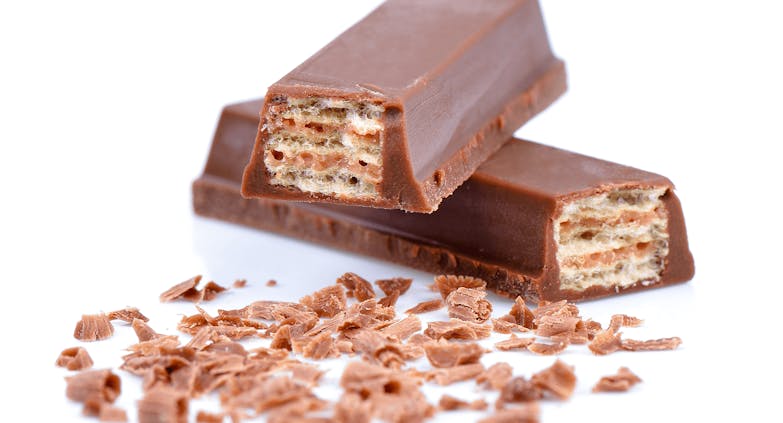
This is where it gets good. These weren’t your bog-standard four-finger bars. The stolen shipment was made up entirely of KitKat’s new Formula 1 Chocolate Car Figures: limited-edition novelty bars moulded into the shape of an F1 racing car, made from a milk chocolate shell with a creamy filling and embedded crispy cereal pieces. They weigh 29 grams each and retail at £1.25 a pop. Nestlé launched them in January 2026 as part of a multi-year deal making KitKat the Official Chocolate Bar of Formula 1. They’re produced at the San Sisto factory — the same one the lorry departed from — and they’re currently only available in a handful of countries including the UK, Italy, Australia and Saudi Arabia.
The maths checks out perfectly: 413,793 bars at 29 grams each comes to 11,999,997 grams, which is 12 tonnes to the nearest kilogram. Someone at Nestlé has counted every single chocolate racing car that was on that truck. They just don’t know where any of them are.
How much is that actually worth?
At the UK retail price of £1.25 per bar, 413,793 F1 KitKats have a theoretical shelf value of just over £517,000. Wholesale prices are significantly lower — probably somewhere in the region of £200,000 to £300,000 — but even at wholesale, this is a more valuable haul than it would have been if they’d nicked standard KitKats. Limited-edition branding, novelty appeal, and an F1 tie-in all push the price up.
Which, for a heist involving a stolen lorry and an international investigation, is still not enormous money. You’d get more jacking a single high-end car (a real one, not a chocolate one). But as we’ll see, the economics of chocolate theft have their own peculiarities.
Why on earth would someone steal a lorry full of KitKats?
Because you can sell them pretty easily. And that’s the thing about confectionery theft that makes it so appealing to organised criminals: chocolate is a near-perfect product to steal.
Chocolate doesn’t have a serial number (well, it has a batch code, but we’ll come back to that). It doesn’t need to be registered. It doesn’t require documentation to resell. It has a long shelf life. Everyone wants it. And it can be moved in huge volumes without looking remotely suspicious, because that’s how chocolate normally moves: in bulk, in boxes, on pallets. A van pulling up to a corner shop with 500 KitKats doesn’t raise the same eyebrows as a van pulling up to the pub with 50” OLED TVs in the back.
The Transported Asset Protection Association (TAPA), which monitors cargo crime across Europe, has documented food and beverage products as one of the most frequently targeted categories. TAPA recorded nearly 160,000 incidents of cargo crime in 129 countries from 2022 to 2024, and chocolate is specifically flagged as a favourite because of its high value-to-weight ratio and the ease with which it can be shifted through informal sales channels.
The thieves may not even have known they were targeting KitKats. Transport lorries are often deliberately unbranded, so from the outside you can’t tell what’s inside; doubly true if they turn out to be carrying Kinder Eggs. These are frequently opportunistic thefts. Someone targets a vehicle at a service station or an unsecured stop, and only discovers what they’ve actually got after the fact. It’s entirely possible that whoever nicked this truck was hoping for electronics or spirits and ended up with 12 tonnes of chocolate racing cars. Imagine their faces.
That doesn’t, however, mean they were without options.
Wait, is there a black market for Easter chocolate?
There absolutely is. And if it was targeted, then the timing is probably not a coincidence.
The theft happened the week before Easter, when demand for chocolate is at one of its annual peaks and prices are at their highest. Cocoa prices have been volatile for years, and the cost of chocolate has risen sharply. A stolen consignment of branded confectionery, arriving into the grey market at Easter, can be moved quickly through discount retailers, market stalls, independent shops, and informal distribution networks across Europe. No questions asked, cash in hand, everyone’s happy. The buyers get cheap stock. The sellers get rid of hot goods (presumably before they melt). And the customer is having a break, having a KitKat.
This is not a new phenomenon. In 2023, a British man called Joby Pool was jailed for stealing 200,000 Cadbury Creme Eggs from an industrial unit, making off with them in a stolen truck. Which, again: very funny headline. Less funny when you learn that the informal market for reselling that kind of haul is well-established, lucrative, and extremely hard to police.
The F1 angle adds a wrinkle here. These aren’t generic chocolate bars that could have come from anywhere. They’re novelty items with distinctive packaging and a specific shape. That makes them slightly harder to shift through the usual grey-market channels. A crate of unmarked chocolate is easier to explain than a crate of chocolate F1 racing cars. But it also makes them potentially more desirable. Limited-edition confectionery has a market, particularly around big sporting events, and the F1 connection gives them collectible cachet that a standard four-finger bar doesn’t have.
What could you actually do with 413,793 chocolate F1 cars?
I’m glad you asked, because I’ve been doing maths and I’d hate for it to go to waste.
The KitKat F1 Car Figure is roughly 10cm long (it’s a stylised racing car, so think Hot Wheels scale rather than Scalextric). Lined up nose-to-tail in the world’s most chocolatey traffic jam, 413,793 of them would stretch approximately 41.4 kilometres. That’s just under the length of the Channel Tunnel. It is, for the avoidance of doubt, the longest chocolate grid in motorsport history.
If you tried to stage a race with all of them (and at this point, why wouldn’t you), you’d have a starting grid 20,689 cars wide and 20 rows deep. The current F1 grid has 20 cars. This one would take approximately four and a half hours to get through a single formation lap, even if everyone drove perfectly, which they wouldn’t, because they’re made of chocolate.
If you ate one a day, it would take you 1,133 years to get through them all. You’d have started during the reign of Henry I and you still wouldn’t be finished. If you somehow managed to eat them all in one sitting (please don’t), at approximately 155 calories per 29g bar, you’d consume roughly 64 million calories. That’s about 87 years’ worth of food for an average adult, or since the good originated in Italy, roughly the same caloric energy as 18 tonnes of pasta.
And at the UK retail price of £1.25 each, if you tried to return them all to Tesco you’d need approximately 20,690 carrier bags and, at 5p a bag, would spend £1,034.50 just on the bags. You’d also need to explain to the customer service desk why you’ve arrived with a lorry full of stolen chocolate, which is probably where the plan falls apart.
None of this helps find the lorry, but it feels important to have established.
Will the KitKats be found?
Probably not. Or at least, probably not all of them. Nestlé has pointed out that every stolen bar carries a traceable batch code, and they’ve asked anyone who finds a match to report it. Which is a nice idea in theory. In practice, the number of consumers who scan the batch code on a novelty chocolate they’ve just bought from a newsagent is vanishingly small. The bars will almost certainly enter the grey market across multiple European countries, be sold at a discount, and be eaten by people who have absolutely no idea they’re consuming the proceeds of an international chocolate heist.
The distinctive F1 shape might help. Unlike a standard KitKat, a chocolate racing car is recognisably unusual. If they start turning up in bulk at market stalls or discount shops that don’t normally carry them, someone might notice. Then again, “someone might notice” is not exactly a Holmsian level of investigative technique.
Nestlé’s York factory alone produces three to four million KitKat bars every single day. Over a billion are eaten in the UK each year. Against that kind of volume, 413,793 bars is a blip. The company has confirmed that supply is not affected. Your Easter KitKat is safe.
The lorry, though? That’s somewhere in Europe with its doors open and its cargo bay empty, and I think we can all agree that whoever abandoned it probably deserves to have a break. Let’s hope they saved one for themselves. They deserve a break.

< Back to articles