
The car insurance question that could leave you uninsured and with points on your licence



Do you use your car to commute to work? If your insurer doesn’t know about it, and you get pulled over on the way to the office, you could end up getting slapped with “driving without insurance”, an offence that comes with six points on your licence and a fine.
It doesn’t even matter if you have car insurance. If you haven’t added “commuting” to your cover, you could get treated as though you’re not insured at all. It doesn’t seem fair, as it’s often just a life admin error on your part or a simple misunderstanding of the terms.
But, it does happen and it can land you in trouble. Beyond the points and fine, you could end up finding it harder to get insured again and when you do get a policy, your premiums could be a lot higher.
What insurance do you need to travel to work?
If you’re travelling to and from a permanent place of work every day, you need what’s known as a “social, domestic, pleasure and commuting” policy. The commuting bit is what makes your policy valid for travel to and from work. You need this even if you’re travelling to a train station and catching the train to your workplace, for example.
If you’re not using your car to drive to work, you can take out what’s known as a “social, domestic, and pleasure” policy, which is often abbreviated to “social only” on comparison sites. This type of policy covers you if you use your car to see friends and family, or go to the shops. It’ll suit remote workers, commuters who never use their car to get to work, or people without jobs.
Do you need to add commuting to your policy if you’re a student travelling to college or university?
This is where things get tricky. When I looked into it, there were lots of different answers to the same question. Some claim that as you’re a student and not in “paid” work, you don’t need to add commuting to go to school. Others claim you’re still commuting to your place of education frequently, so it does count as a commute.
Comparison sites aren’t any help either. Confused.com defines commuting as “a commute to a permanent place of work”. But, Compare the Market defines commuting as “driving to and from a single place of work OR study”.
Exactly what you’re covered for will probably depend on your insurer. So, I’d say reading the policy wording or even ringing your insurer might be a good idea in this case. Getting caught out is just not worth it, especially as adding commuting isn’t as expensive as you might think.
How much does it cost to add commuting to your policy?
Exactly how much it costs to add commuting to your policy will really vary depending on your personal circumstances and that includes everything from how long you’ve had your licence, what type of car you have, where you live, what your job is, and lots of other factors.
But, I ran a few quotes, and I found that for experienced drivers, adding commuting sometimes doesn’t add to your premium at all. That’s partly because some insurers don’t distinguish between social and social and commuting at all, they just lump them into one policy regardless. So, you wouldn’t pay anything extra for this add-on.
In other cases, for less experienced drivers, the difference was negligible. I'm talking somewhere between an extra £5 to £20 per year for the peace of mind this add-on can offer.
Based on these quotes, it’s very likely that people who don’t add commuting to their policy are probably not doing it to cheat the system and save cash. For many, it might be a case of forgetting to update their policy when they get a new job. Or, a simple misunderstanding.
Is it always obvious you need to add commuting to your policy?
I looked at three different comparison sites to work out whether it’s obvious you need to add commuting to your car insurance policy if you’re using your car to travel to work.
Compare the Market, Money Super Market, and Confused.com all offered information about what the different types of policies meant, but some were clearer than others in their definitions.
All three asked a variation of “What do you use the car for?” to work out whether you’re a social user or commuter.
Then, all three offered a variation of “social only” or “social and commuting”. But, while Compare the Market offered a sentence under each insurance class to define what is meant, Money Super Market did not.
Instead, to work out what each insurance class meant, you had to click through an inconspicuous link to the side that said “Need help?” to then get a detailed breakdown of what each type of insurance entailed. I think this could be easily missed when you’re filling out a lengthy car insurance form.


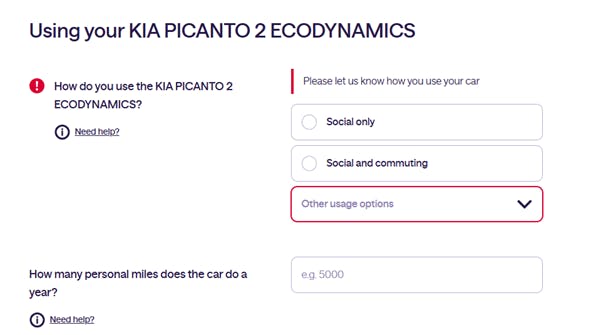
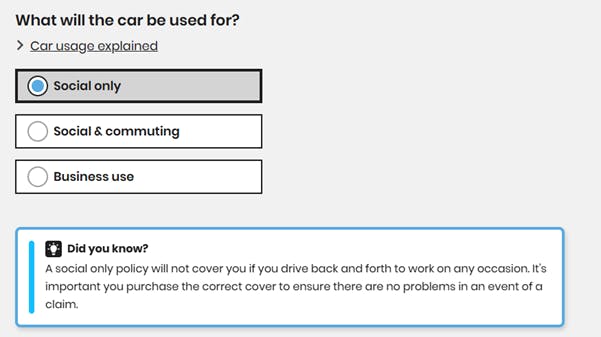
Confused.com, I think, did it best. It didn’t define what each class of insurance meant at the outset, but right below the “What will the car be used for?” question, there was a “Car usage explained” link that you could tap to read about the different types of insurance.
And, when I tried ticking “Social only”, a pop up appeared beneath the question warning me that “a social policy will not cover if you drive back and forth to work on any occasion”.


But, ultimately, regardless of who did it best and even the fact that it’s downright confusing on some sites, it’s your responsibility to get the right insurance in place. If you don’t, you could get slapped with fines, points on your licence, and increased premiums and all down to a technicality that won’t cost you more than a couple of pounds per month to fix.

< Back to articles