
The Renters’ Rights Act is now law: here’s what changed for you



If you rent your home privately in England, last week saw the biggest change to your rights in over 40 years. The Renters’ Rights Act came into force on 1 May 2026, and, if you're a renter, it shifts the balance in your favour in several important ways, covering how and when your landlord can ask you to leave, how much rent they can charge, and how often they can put it up.
Whilst this has been in the works a long time, not everyone is fully up to speed on what this means yet. To help, here is a plain-English guide to what has actually changed and what you can do with these new rights.
What changed on 1 May 2026
The table below covers the main changes that came in with the Act. Everything in the right-hand column now applies to your tenancy, whether you moved in recently or have been in the same place for years.


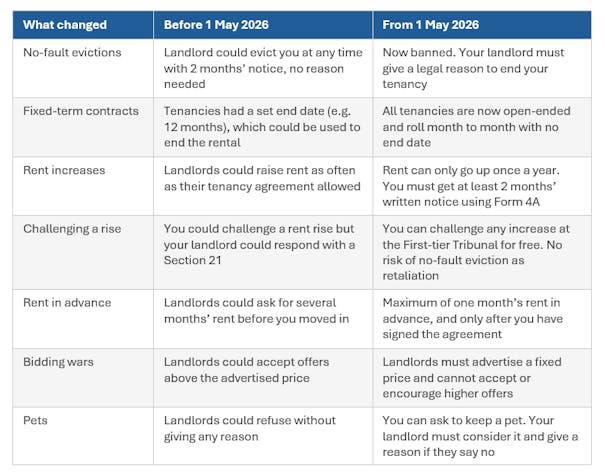
All of the changes above apply to both new and existing private tenancies in England. If you have a social tenancy (council or housing association), similar protections will be introduced in a later phase of the Act.
What was Section 21, and why does it matter that it’s gone?
What is a Section 21 eviction?
A Section 21 notice was the mechanism that allowed a landlord to ask you to leave your home without needing to give any reason. All they had to do was give you two months’ notice in writing. It did not matter if you had kept up with rent, looked after the property, or lived there for a decade, you had no right to appeal.
For many renters, particularly those on low incomes or in areas with limited housing, Section 21 cast a long shadow. People tolerated problems with damp, repairs that never got fixed, and rent rises they could not really afford because complaining felt too risky. If your landlord took against you, they could simply serve notice and that was that. This now gives some power back to renters.
From 1 May 2026, landlords can no longer issue Section 21 notices for any tenancy in England, whether it started before or after that date. If your landlord wants you to leave, they now need a specific legal reason, and they have to give you the correct amount of notice, which is usually four months.
If you received a Section 21 notice before 1 May 2026 and have not yet left your home, the situation is slightly more complex. Your landlord had until 31 July 2026 to begin court proceedings using that notice, so it is worth checking whether this applies to you. Shelter’s free advice line (0808 800 4444) can talk you through your specific position.
Rent rises: what your landlord can and cannot do
Your landlord can only increase your rent once every 12 months, and not at all in the first year of a new tenancy. When they do want to put the rent up, they must use a specific official form called Form 4A and give you at least two months’ written notice before the change takes effect.
Any other method of raising the rent, including clauses in your tenancy agreement that link it to inflation or informal arrangements, no longer has any legal effect. If your landlord tries to raise the rent without following this process, it is not valid.
If you think a proposed increase is above market rate, you can challenge it at the First-tier Tribunal. You do not need a solicitor and there is no risk that your landlord can retaliate with a no-fault eviction, because that route no longer exists.
How to challenge a rent increase
To challenge a rent rise, you need to apply to the First-tier Tribunal before the date the increase is due to take effect. While the case is being heard, you keep paying your current rent and the increase is paused. The tribunal will set what it considers the fair market rent for your home. It can keep the rent the same as your landlord proposed or reduce it, but it cannot set it higher than your landlord asked for. You can find Form Rent 1, which you need to start the process, at gov.uk.
What to do right now
There are a few things worth checking this week if you rent privately in England.
Check for your information sheet. Your landlord or letting agent should have given you the government’s official Renters’ Rights Act information sheet before 31 May 2026. If they have not, they can be reported to your local council, who have the power to issue fines of up to £7,000 for a first offence. The sheet explains your new rights in plain language and is worth reading.
Check any rent increase you have received recently. If your landlord sent a rent increase notice after 1 May without using Form 4A and giving you two months’ notice, it may not be legally valid. If something does not look right, contact Citizens Advice or Shelter for free guidance before you agree to pay the new amount.
If you want to ask for a pet, you can now do so in writing. Your landlord must consider the request properly and give you a reason if they say no, rather than simply refusing.
If you got a Section 21 notice before 1 May 2026, contact Shelter as soon as possible. The deadline for your landlord to use it in court is 31 July 2026, so the clock may already be ticking.
What’s coming next
The Act is being introduced in phases. Later in 2026, a new Private Rented Sector database will be rolled out gradually by area, where every landlord and every rental property in England will need to be registered. A new Private Rented Sector Ombudsman will also be set up, giving tenants a free, impartial way to raise complaints about landlords without going to court.
By 2030, privately rented homes will also need to meet minimum energy efficiency standards, which should mean better insulation and lower bills for tenants in properties that currently cost a lot to heat.
Where to get help
These organisations offer free advice and are genuinely on your side. You do not need to pay anyone to understand or enforce your rights.
• Shelter: 0808 800 4444 (free), or shelter.org.uk for online advice on all renting and housing issues
• Citizens Advice: 0800 144 8848 (free), or citizensadvice.org.uk
• Generation Rent: generationrent.org, which campaigns for renters and publishes plain-English guides on new legislation
< Back to articles